Gabriele Albertini
Mechanics of Materials and Structures
© 2020 Gabriele Albertini
| Research | Publications | Software | Contact | Open Positions |
|---|---|---|---|---|
Friction
Pulse dynamics at soft-rigid interfaces: Why do basketball shoes squeak?
We show that opening slip pulses racing along the frictional interface are the underlying mechanism producing the squeaking sound. When the pulses are confined by geometric patterning of the sliding surface, they occur in an ordered, periodic manner, and the resulting squeak is clean, with a clear dominant frequency. Conversely, in the absence of patterning, the pulses behave chaotically, giving rise to a scratch-like sound containing a broad distribution of frequencies.
Djellouli, A.1, Albertini, G1., Wilt, J., Tournat, V., Weitz, D., Rubinstein, S. and Bertoldi, K., (2026), “Squeaking at soft–rigid frictional interfaces”, Nature. 1Equally Contributed
You can also read about our work on phys.org, Science News, or in The Conversation and in this interview with The Naked Scientists.
Nucleation of slip patches mediates the onset of frictional motion
How does random local strength affect the static friction coefficient?
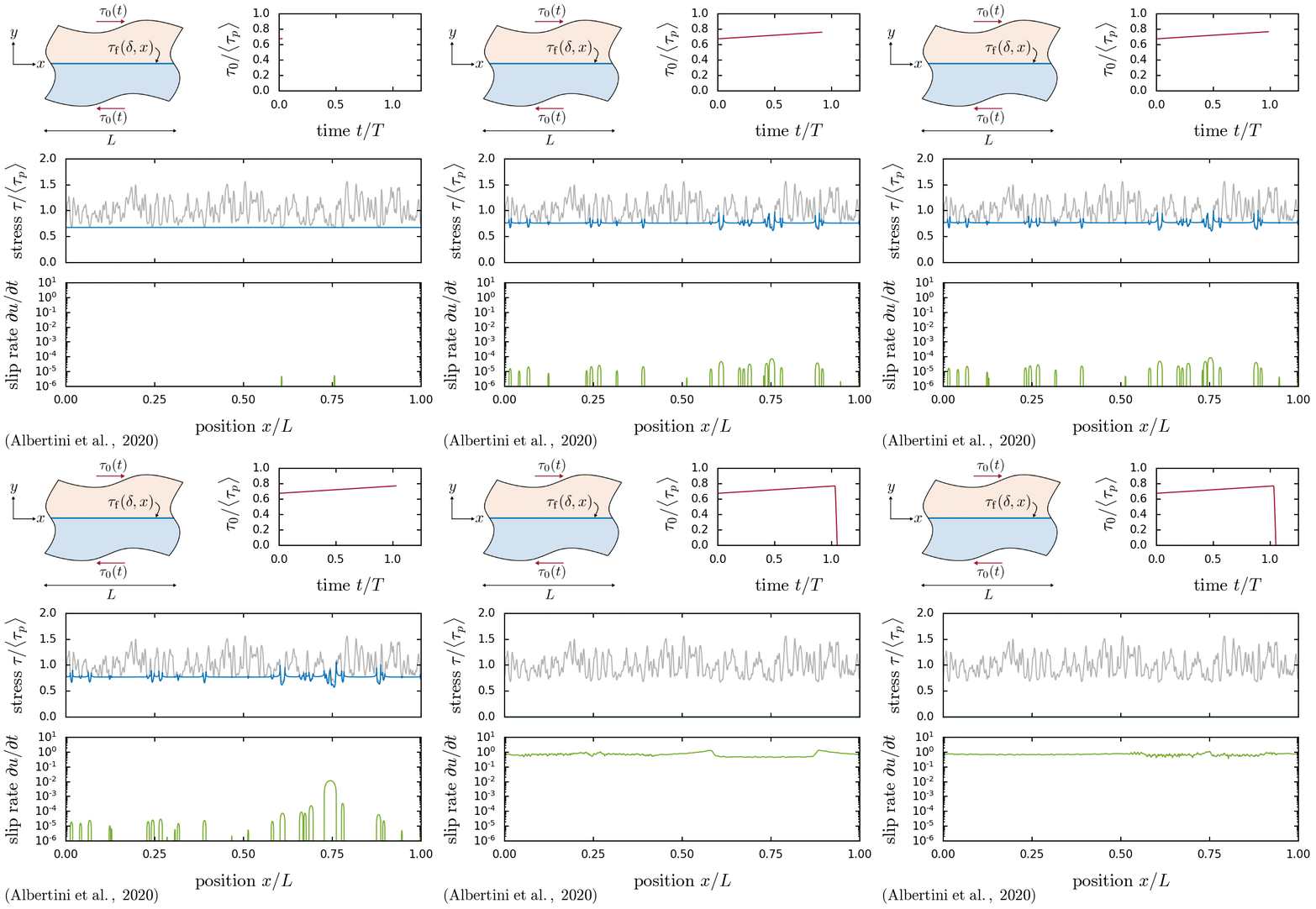
Albertini, G., Karrer, S., Grigoriu, M. D., Kammer, D. S., 2021. “Stochastic Properties of Static Friction”, Journal of the Mechanics and Physics of Solids 147, 104242.
Friction is Fracture
The onset of frictional motion is characterised by the propagation of slip fronts, which – like cracks – break the discrete contacts at the frictional interface allowing sliding to occur. In this study, we combine friction experiments with fracture-mechanics simulations and theory to study long sought-after interface properties, such as local fracture energy and frictional peak strength.
Svetlizky, I.1, Albertini, G.1, Cohen, G., Kammer, D.S. and Fineberg, J., 2020.
“Dynamic fields at the tip of sub-Rayleigh and supershear frictional rupture fronts”,
Journal of the Mechanics and Physics of Solids 137, 103826.
1Equally Contributed
Earthquake source mechanics
Ma, X., Hajarolasvadi, S., Albertini, G., Kammer, D.S., Elbanna, A.E., 2019. “A hybrid finite element-spectral boundary integral approach: Applications to dynamic rupture modeling in unbounded domains”, International Journal for Numerical and Analytical Methods in Geomechanics 43, 1, 317-338.
Albertini, G., Kammer, D.S., 2017. “Off-fault heterogeneities promote supershear transition of dynamic mode II cracks”, Journal of Geophysical Research: Solid Earth 122, 2017JB014301.
Fracture
Breaking fast and slow: How do crack propagate in 3D?
When cracks slowly move forward in a 3D brittle material, they do so because of accompanying dynamic cracks propagating perpendicular to the main direction of motion.
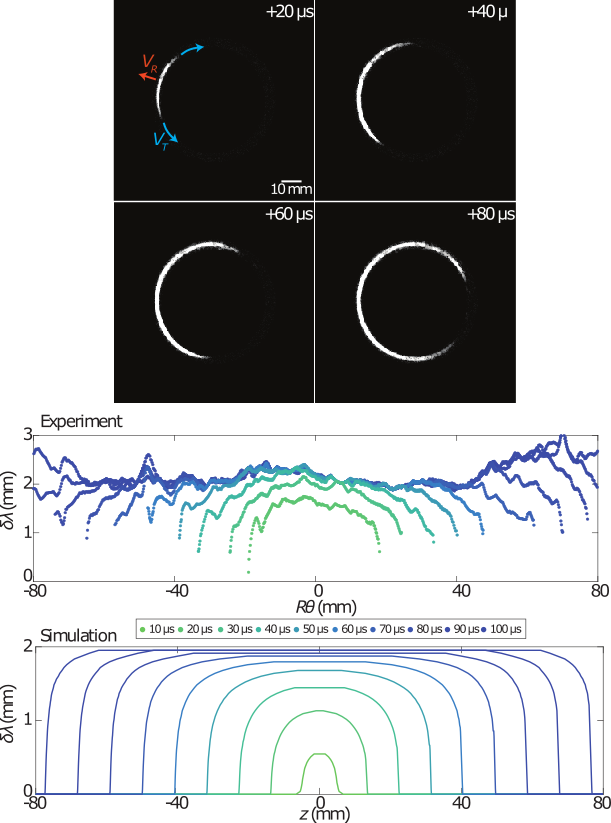
Cochard, T., Svetlizky, I., Albertini, G., Viesca, R., Rubinstein, S., Spaepen, F., Yuan, C., Denolle, M., Song, Y.Q., Xiao, L., Weitz, D., 2024. “Propagation of extended fractures by local nucleation and rapid transverse expansion of crack-front distortion” Nature Physics.
What happens when a crack gets trapped by an obstacle of higher fracture energy?
The crack adapts instantaneously its propagation speeds. The speed jump amplitude is governed by the crack tip energy balance, as predicted by brittle fracture theory.
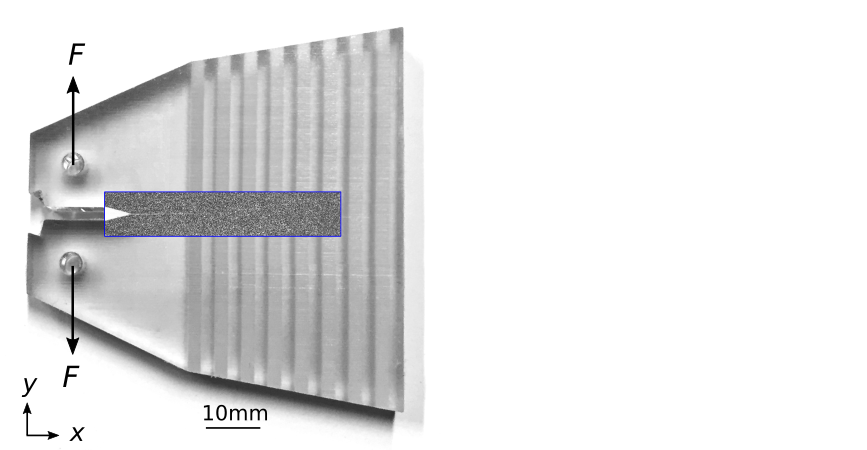
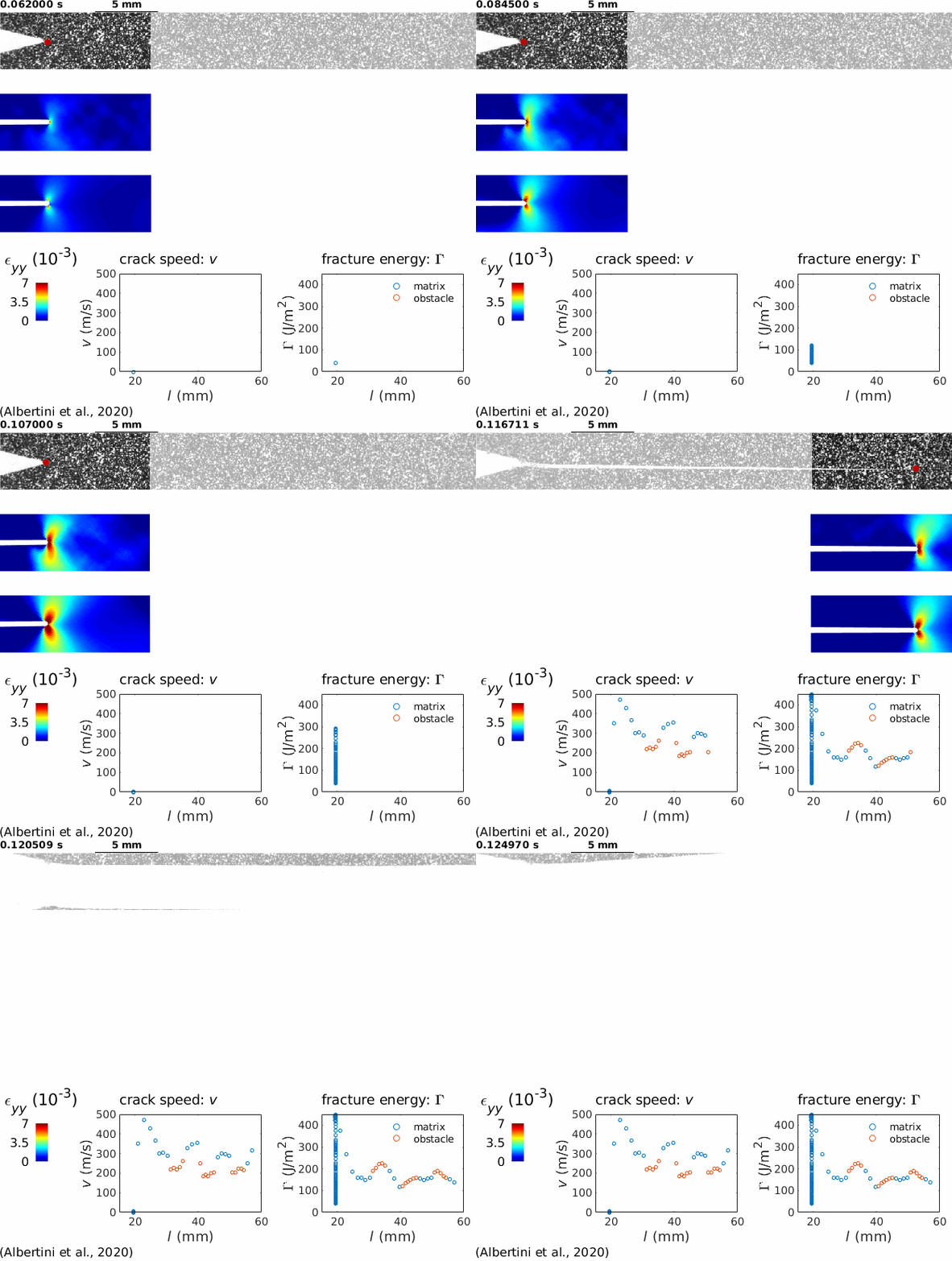
Albertini, G., Lebihain, M., Hild, F. Ponson, L. and Kammer, D.S., 2021, “Effective toughness of heterogeneous materials with rate-dependent fracture energy”, Physical Review Letters 127, 035501. arXiv:2003.13805